Product
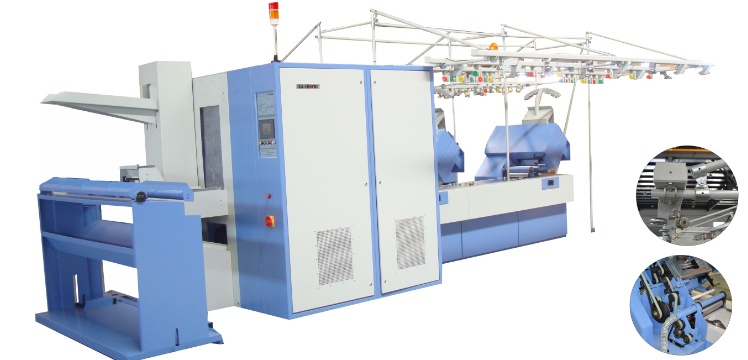
(1) Flat Belt Flexible Winding System
A flat belt flexible winding mechanism was developed, in which the fiber layers, after passing through the compression rollers, are wound under the influence of friction between the flat belt and the bobbin. The flat belt features flexible constraint winding, with a 280° large-angle wrap-around surface contact small roll, improving the clarity between fiber layers and the winding speed.
(2) Online Winding Control and Adjustment Device
An online control and adjustment device for flat belt winding was developed, capable of real-time control and adjustment of the operating status of the high-speed moving flat belt, ensuring normal operation and production quality.
(3)Online control of winding pressure
The center of the new type of cotton roll positioning fiber layer winding tube remains unchanged, and the fiber roll density remains consistent from small roll to full roll. The fiber roll does not stick or loosen during the entire working process, improving the weight unevenness rate. The weight unevenness rate of small rolls is ≤0.5%.
(4) New Type of Pipe Gripping Mechanism
Optimized design of the pipe fine-tuning device for adjusting and securing the position of the pipe gripping mechanism, and accurate coordination between the pipe feeding mechanism and the clamping plate center, etc. This avoids the decrease in gripping force and pipe detachment due to air pressure fluctuations or abnormalities. (5) Cotton Layer Control Mechanism
The dual-cylinder single-direction control mechanism ensures good stability. When the fiber roll reaches a fixed length, both sides fold towards the center, allowing the fiber roll to smoothly wind onto the bobbin. During unwinding, it quickly locates the beginning of the cotton layer, achieving automatic completion in production and improving operating efficiency.
(6) Intelligent Automatic Bobbin Feeding Mechanism
It has two functions: automatic bobbin feeding and storage. Using a horizontally arranged bobbin arrangement, it fully utilizes the distance between the equipment guide rail and the main body for automatic and continuous feeding. The mechanism is stable, and bobbin placement is easy and convenient.
(7)Optimized design of machine body structure
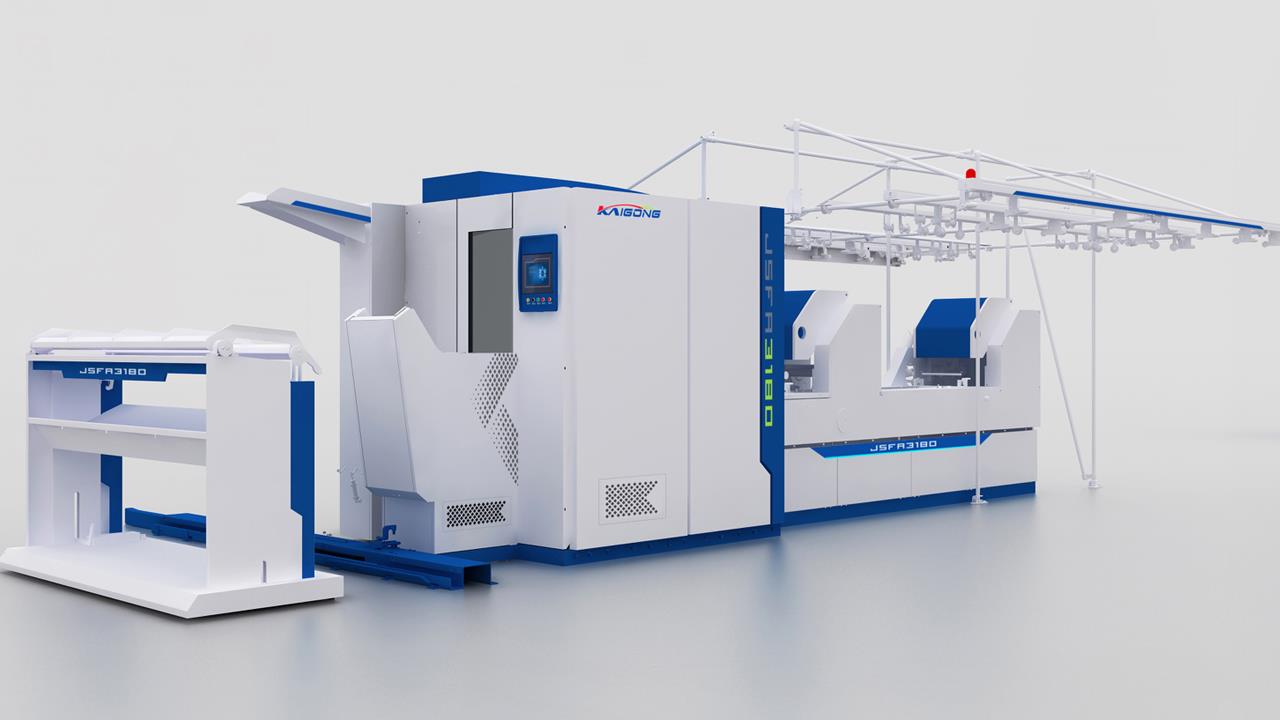
The optimized design of the machine body reduces the volume of the frame, reducing the footprint of the equipment from approximately 40 m2 (600 mm strip drum) of the traditional strip-winding combined machine to 28 m2, which facilitates worker operation, saves factory land, and reduces overall costs. (8) Optimization of the drafting mechanism transmission
The drafting system adopts a flat belt drive, similar to that used in combing machines, eliminating the need for process gearboxes, universal couplings, and other components. Components such as the drafting seat, main frame wall panel, and flat belt are all from combing machine parts, allowing for flexible and convenient process modifications. Furthermore, consumables such as belts, roller supports, and bearings are interchangeable with those from combing machines, reducing spare parts inventory and simplifying operation. (9) Development of the Control Program
Based on the control points, form, and fiber roll forming requirements, the overall machine control program is optimized to achieve simple operation and convenient maintenance, and to have user-friendly data statistics, fault information feedback, and local area network information transmission functions. The pressure curve adjustment and upgrade required for small roll forming can be achieved simply by pressing a button on the control panel; the human-machine interface is user-friendly.